How to clean a washer drain hose, and when to replace it or call a plumber
A quick spin test shows if the clog is likely in your house drain or the hose and washer. Then clear the clog, replace the hose, or call a plumber.
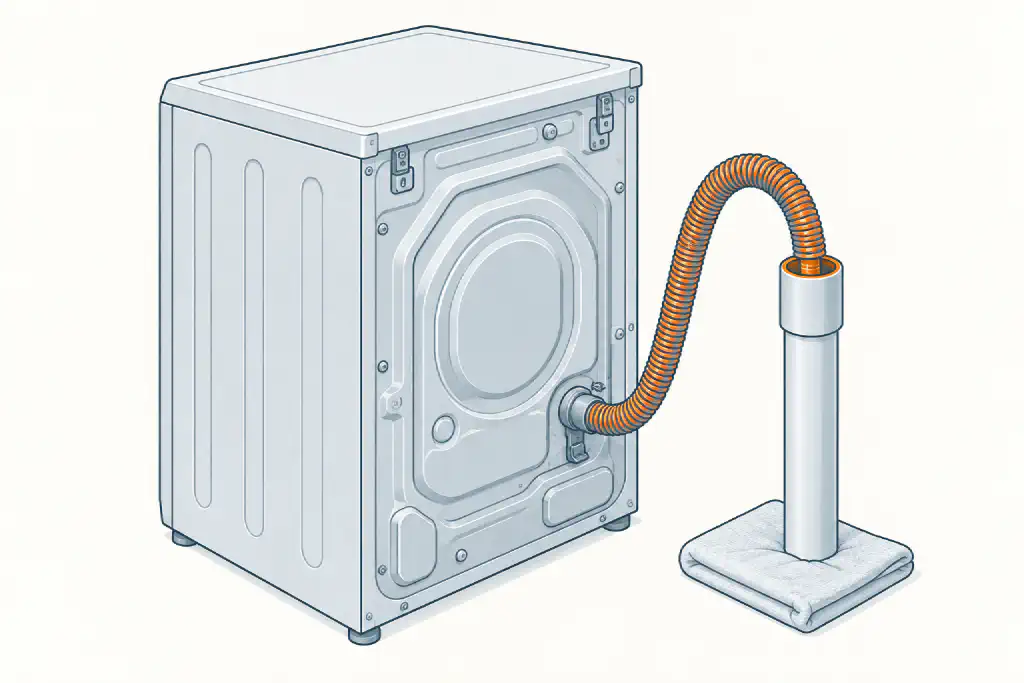
Slow draining or water left in the drum? Another cleaning cycle won’t clear a kinked hose or a clogged drain pipe, so find the blockage first. Drains fine but smells? See why the smell comes back, or for rotten eggs, where the smell is.
Hose or house drain? A quick spin test
LG gives this test for its front-loaders. Our reading: it works on any washer that spins.
- Unplug the washer. Turn off the water valves behind it and lay a towel down, as Western Rooter, a plumbing company, does before hose work. Have a tray and bucket ready; we’d let a hot wash cool.
- Move the hose end into a sink or bucket. In a bucket, hold the end about as high as it sat in the pipe and watch the level: before it fills, pause the cycle, lift the end high, empty the bucket and resume (our suggestion).
- Run a Spin-only cycle (or Drain and Spin). Plug in only for this, then unplug again.
| What comes out | Where the problem likely is | Go to |
|---|---|---|
| Strong flow, but kitchen or bath drains are slow | Often past the hose, says Western Rooter | Plumber |
| Strong, steady flow | Your house drain: LG says you “may need to unclog your home’s drain” | Clearing the drain pipe |
| A trickle or nothing | The hose or the washer (our reading) | Kinks and damage |
Check the hose for kinks and damage
With the washer unplugged and the water off, slide it out and follow the hose to the drain. On its front-loaders, LG notes, washer vibration can kink or pinch it, and Samsung says it should “run smoothly from the washer to the home’s drainage system.” Straighten it, as Whirlpool advises. Straightened a kink? Retest. Cracked or leaking? Replace it. Neither? Clean it.
Clean it or replace it?
Samsung says, “Damaged hoses and o-rings should be replaced,” and for a damaged drain hose on its washers, to request service. Other brands: we’d fit the part your manual or maker lists, then retest.
How to clean the drain hose
Whirlpool says to remove any blockage, but none of the maker support pages we read gives a method. Ours uses plain water. Washer unplugged, water off, towel and tray down:
- Check for a holding screw. Samsung says not to remove the screw that holds the drain hose against the back of the washer. If yours has one, skip to the won’t-come-off steps (our call).
- Detach the hose at the back, if it comes off there (on Whirlpool front-loaders it does), with the tray under the connection.
- Flush it with tap water over a laundry sink or tub until water runs straight through. Pull out any lint you can reach.
- Reattach it firmly.
Retest it
With the drain end in the bucket, plug in, rerun the spin test, then unplug. Strong flow? Hook the hose back into the drain pipe, turn the water on, plug in and run Drain and Spin. Draining well? See if it still smells. Still a trickle? See below.
If the hose won’t come off
With the washer unplugged and the water off, straighten the hose and clear any lint from its end. Then retest.
Western Rooter suggests an empty hot cycle with baking soda, then one with vinegar. We skip it: our cleaners page says to pick one. Whatever you use, never mix bleach with vinegar, ammonia or other cleaners, or run one straight after the other. Western Rooter also says harsh chemical drain cleaners “can damage rubber hose connections.”
Still a trickle?
The blockage is likely in the washer, or in a hose you couldn’t remove. On a front-loader, clean the drain filter next; that page covers the towel and tray. On a top-loader, check your manual for a lint screen or filter. Still a trickle? Book a maker service visit (our call), and keep the washer unplugged until then.
Clearing the drain pipe
With the washer unplugged, the water off, and a towel and bucket ready for water left in the hose and pipe (Hoffmann Brothers says residual water may spill), take the hose out:
- Look down the pipe with a flashlight for lint or stuck objects, as Hoffmann Brothers, a home-services contractor, advises.
- Pull out what you can reach.
- Snake it if the clog is further down. Western Rooter suggests a 15 to 25 ft hand snake. One example: Cobra 1/4 in. x 25 ft drum auger ad . Its listing names sink, shower and tub drains, not a laundry standpipe, so check it suits yours.
- Skip boiling water. It “can stress older PVC joints,” Western Rooter warns.
- Hook the hose back in firmly, as Hoffmann Brothers advises. Turn the water on, plug in and run Drain and Spin. Draining well? See if it still smells. Still slow, or couldn’t clear it? Call a plumber.
When a slow drain is a plumber job
Couldn’t clear the pipe, or still slow after? Call a plumber. Western Rooter also lists four signs: the drain backs up again within about a week of cleaning, several drains are slow, a sewer smell stays after a thorough hose and drain-pipe clean, or water pools on the floor during a drain cycle. Until the plumber has been, we’d leave the washer unplugged, water off.
Draining again but still smelly?
If the musty smell returns within weeks, read why the smell comes back. Sewer smell in the room? Check the dry trap first, and call a plumber if it stays.