Clothes still smell like sweat after washing? Why, and how to wash them
Gym clothes or shirts still smell of sweat after a wash? Why polyester can hold body odor, how to tell it from a musty smell, and what makers advise.
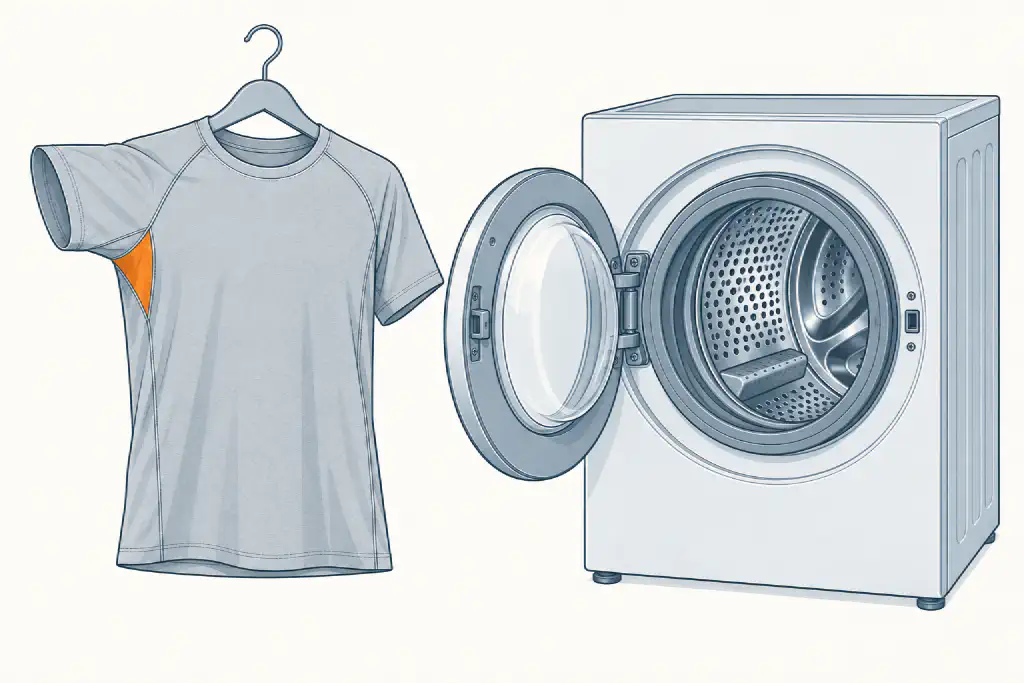
The shirt or gym top came out of the wash looking clean, and the armpits still smell of sweat. Maybe it went through twice, or with extra detergent and a scent booster. It’s a known problem: Tide, a P&G detergent brand, warns of “a closet full of clothes that still smell of sweat even after washing”. Read on for why polyester can hang on to the smell (below) and the makers’ wash advice. If it smells damp, sour or musty instead, or it’s towels, sort that first.
Is it sweat, or a musty laundry smell?
- The armpits or collar of clothes you wore still smell of sweat straight out of the wash. It’s probably sweat the wash didn’t shift. Read on.
- Fine out of the wash, but it smells once worn or damp again. It could be either. If what you smell is damp, sour or musty, start with the musty-laundry guide in the next bullet. If it’s BO in the armpits, read on.
- The whole load smells damp, sour or musty, including things nobody sweated in. See why clothes smell musty or sour after washing.
- Towels smell fine dry but sour once wet. See why towels smell when wet.
Here’s why the worn-or-damp case could be either. Researchers including staff at Kao, a Japanese detergent maker, studied a smell that people in Japan noticed on laundry hung to dry indoors or “when using their already-dried laundry”. It is often described, they write, as an “acidic or sweaty odor”.
Why polyester can hold on to sweat smell
In one University of Alberta study, polyester smelled of sweat more strongly than cotton, even after washing. The study had 8 people wear T-shirts that were half cotton and half polyester for 20 exercise sessions over 10 weeks. The shirts were washed in between, and odor was measured before and after the 20th wash. The researchers found that:
- before washing, odor acids were more common on the polyester
- bacteria counts didn’t differ between the two fabrics
- washing cut the odor on both fabrics
- the polyester side still smelled stronger, “not just before, but also after washing”.
The authors suggest the buildup in polyester “may be cumulative”, because important odorants “were not as effectively removed from polyester compared to cotton”.
If your gym clothes are polyester, a lingering smell matches what this one study found. It isn’t proof you washed them wrong. The steps below are the makers’ advice for giving the wash its best shot.
How to wash clothes that smell of sweat
- Wash them soon, and hang them up to dry first. The longer clothes spend “brewing in your cocktail of sweat in the laundry hamper, the harder it will be to remove the odor”, according to Tide. Its rule for the meantime: “Always allow sweaty clothes and towels to air dry before tossing them in the laundry hamper.” That’s the line to hand a teenager: hung up, not balled up in the hamper.
- Turn shirts inside out. Sweat and grime from your body “accumulate on the inside of your clothing”, per Tide.
- Leave room in the drum. Tide’s test is enough space “for your palm to fit between your clothes and the wall of the drum”.
- Let the care label set the temperature. Tide’s advice is warm water “if allowed by the garments’ fabric care label”. Nike’s workout-clothes guide advises cold water on a gentle cycle, so workout clothing doesn’t “shrink or lose its shape”. They differ, so the garment’s label settles it.
- Detergent: read the package, and no bio (enzyme) detergent on wool. For wool, merino included, Woolmark’s advice is to avoid “heavy-duty detergents, ‘bio’ detergents containing enzymes, or any detergents containing bleaches”, and to use a mild wool detergent. For other fabrics, check the care label; bio is an option, not a must. Persil in the US, made by Henkel, says that whether it’s mud or “post-workout sweat”, the enzymes in its Original and Intense Fresh detergents “tackle bio-based stains”. If the package gives a pre-soak or pre-treat method, follow it.
- Workout clothes: dose to the line, no softener. For workout clothes, Nike’s guide says to use “the recommended amount of detergent, but avoid adding extra”, because detergents and boosters “can leave a residue on workout clothing that can trap odors”. Fabric softeners, it adds, “can leave behind a coating that may further trap bacteria”, so it’s best to avoid them when washing workout clothes. The musty-laundry guide explains why too much detergent can trap smell.
- Air-dry activewear. “High heat can damage the fibers in performance fabrics,” Nike’s guide warns. It suggests air-drying where possible, or a no-heat or low-tumble dryer setting.
Still smells of sweat after all that?
Check the steps above again, especially washing soon (step 1) and the dose and softener points (step 6), plus any pre-soak method on your detergent package. A well-worn polyester top may also simply be holding some of the smell (see above).
Next, sniff the empty washer with the door or lid open. On a front-loader, check inside the folds of the rubber door gasket and the detergent drawer. On a top-loader, try the softener dispenser and under the rim. If the washer smells, deal with that first, using the front-loader checklist or where a top-loader hides the gunk.
If what’s left smells damp or sour rather than sweaty, the musty-laundry guide starts with loads left wet and packed drums.