How to clean a front-load washer, step by step
How to clean a front loader washing machine in order: rubber seal, detergent drawer, drain pump filter, then the clean cycle and cleaner your maker names.
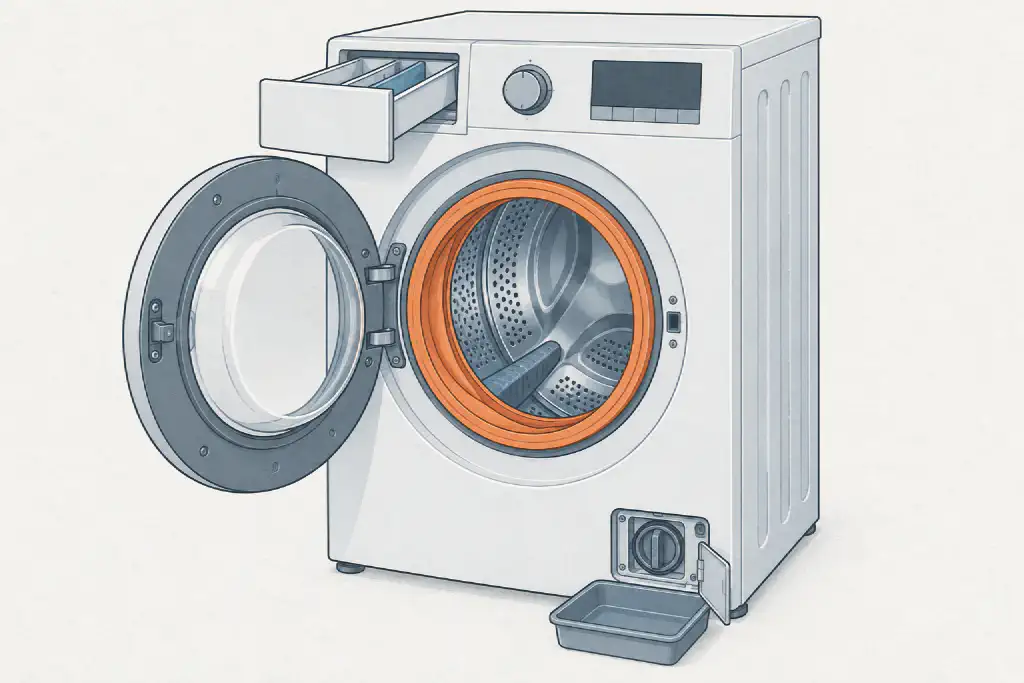
Didn’t know washers needed cleaning? Or you already ran vinegar through yours, and the musty smell came back. On a front-loader, the smell can sit where a cycle doesn’t scrub: the rubber seal, the drawer’s slot and the filter behind the little hatch at the bottom (why). Samsung says a pump filter that isn’t kept clean “will cause odors”. So clean those parts by hand first, then run the cycle. Top-loader? See the top-load routine.
How to clean a front-load washer, step by step
The makers’ pages don’t set one order for these jobs. LG’s US page lists Tub Clean before the filter, and Samsung’s mildew steps clean the pump filter after Self Clean. This order is ours: the by-hand cleaning comes first, so the cycle flushes out what you loosen. Our advice: for steps 2 to 4, use only warm water, mild soap and a soft brush, then wipe the soap away with warm water, as GE says to do on the seal. LG and GE also allow diluted bleach or vinegar on the seal, but soap alone means nothing you wipe on can meet the bleach in the clean cycle. Models differ, so check your manual for yours, especially on an LG.
- Empty the drum and unplug the washer. LG says to turn its washer off and “remove the plug from the outlet” before opening the filter, so do it now.
- Clean the rubber seal (door gasket). Pull the seal back and take out anything caught in the groove at the bottom (LG and GE say to remove foreign objects). Then wipe inside the folds and dry the gasket completely, as Samsung’s Canadian page says. Black gunk that won’t wipe off? See the full gasket clean.
- Clean the detergent drawer and its slot. Pull the drawer out, take out the inserts and brush them under warm water. Then brush the slot: LG says to “thoroughly clean the inside of the dispenser housing”. For releases and the siphon cap, see the drawer guide.
- Drain and clean the pump filter. Samsung says most front-loaders have one “on the front, near the bottom, behind a panel”; LG’s is at the bottom left. If the washer just ran a hot cycle, wait: Samsung’s Canadian page says to “allow time for the water to cool before draining”. With the washer still unplugged, lay a towel down and put a short bucket, baking dish or low pan under it, such as the Performance Tool 2.8-quart low-profile oil drain pan ad (sold for car oil changes; any shallow pan works). Wear gloves, for example Playtex Living reusable rubber gloves ad . Drain the small hose, then unscrew the filter and rinse it under warm water. See the full filter walkthrough.
- Run your maker’s clean cycle on the empty drum, with only the cleaner in the table. Plug it back in, close the hatch, then start it. On a Whirlpool or Maytag, don’t stop the cycle partway: Whirlpool and Maytag say not to interrupt theirs, and they add: “Do not add detergent or other chemicals to the washer when following this procedure.” Never mix bleach with vinegar, ammonia or other cleaners. Mixed, they can give off toxic gas, the Washington State Department of Health warns. Our advice: don’t run one straight after the other either. Not sure which cleaner? Try the cleaning cycle picker, or, with no clean cycle, see the options.
- Leave the door and drawer open to dry. LG says to open both after Tub Clean, and Samsung’s Canadian page says to leave them open after every wash. Whirlpool says to leave the door open between uses. See why it works.
What your maker says to put in the clean cycle
Each row comes from that maker’s front-load or all-washer support page. Models differ, so your manual has the final word. Or pick your maker in the cleaning cycle picker.
| Maker | Cycle | What to add, and where | How often |
|---|---|---|---|
| LG (front-load) | Tub Clean or Tub Sterilization | An oxygen-based washer cleaner, at the dose on its label. LG warns: “Avoid using chlorine-based or acidic washing machine cleaners, as they may cause discoloration or corrosion inside the machine.” Check your manual. | Every 30 uses, or when the display shows tcL |
| Samsung | Self Clean, Self Clean+ or Pure Cycle | Usually nothing; if odors persist, a washer cleaner (Samsung Canada; Samsung US says to follow the cleaner’s directions). For mildew or mold, liquid chlorine bleach in the detergent compartment (steps below) | About once a month, or every 30–40 loads |
| Whirlpool, Maytag | Clean Washer | One affresh tablet at the bottom of the washer basket, not in the dispenser; or 1 cup (236 mL) of liquid chlorine bleach in the compartment your manual names. Nothing else | At least once a month, or every 30 cycles if that’s sooner |
| GE (front-load) | BasketClean or Self Clean | 1 cup of bleach, or a washer cleaner made for the job. GE’s page names no compartment, so check your manual | Once a month |
| Bosch | Drum clean, on some models | See the Bosch note below | — |
| Electrolux, Frigidaire | — | We found no front-load support page; check your manual | — |
Never mix bleach with vinegar, ammonia or other cleaners (step 5).
Bosch
Bosch Australia lists a Drum clean program on models that have it. It recommends the program if you regularly wash at 104°F (40°C) or lower, and says a reminder light flashes when one is due. That page names no cleaner. Bosch US says to use its own washing machine cleaner “every few months” to remove greasy residues, and names no program.
Samsung’s bleach steps, for mildew
Samsung’s mildew steps are only for a mildew smell or visible mold. Run Spin-only to empty the tub. Fill the detergent compartment, not the bleach one, to the max line with liquid chlorine bleach, and start Self Clean right away. Afterward, wipe the tub and run Rinse+Spin. Never mix that bleach with vinegar, ammonia or other cleaners.
No clean cycle?
GE’s front-load page says to run a large Heavy/Cotton cycle with nothing in the drum and the same cup of bleach or cleaner, and to repeat if necessary. Never mix that bleach with vinegar, ammonia or other cleaners. Samsung’s Canadian page says some models use a Normal cycle. For other makes, your manual has the details. For what each cycle reaches, and LG’s other pages, see the clean-cycle guide.
Should you clean it with vinegar and baking soda?
It’s a common tip online, but on a front-loader, see what your maker says first. LG warns against acidic cleaners in Tub Clean (the table). Vinegar is an acid, though LG’s page doesn’t name it. Bosch’s US descaling page says: “We advise you not to descale your washing machine with household products that contain acid or vinegar. These can attack the rubber parts of the machine.” Of the front-load clean-cycle steps in the table, none lists vinegar. For cleaning, Samsung’s US page lists it only for its Sanitize cycle, on models that have one.
Baking soda is a base and vinegar is an acid, and the fizz is carbon dioxide from their reaction, says Whitman College’s science outreach sheet. In a Northern Kentucky University classroom demo with similar amounts of each, “The baking soda will neutralize the vinegar.” Our reading: adding baking soda doesn’t help, because the bubbles are the two canceling each other out, not a sign the washer is getting cleaner.
Our advice: use the cleaner your maker names, and keep vinegar and bleach apart (step 5). For when vinegar does fit, see vinegar vs bleach vs cleaner tablets.
How often should you clean a front-load washer?
The clean cycle: on your maker’s schedule in the table. That’s about once a month for most of them, or every 30 uses on an LG front-loader.
By hand: LG says to clean the “drain pump filter, detergent dispenser, inlet filters, and door gaskets when performing a monthly tub clean” (check your manual for your model). Samsung’s Canadian page says to wipe the door, gasket and detergent area weekly. For the drawer and pump filter, it gives every 1–3 months. Another part of the same page says about once a month for the drawer, and at least once a month (or about every 40 washes) for the pump filter.
Still smells after the routine?
Still musty right after the routine? See what the routine can miss. If the smell was already set in, LG’s US page says to run Tub Clean once a week for 3 consecutive weeks, and to request a repair if the problem persists (your manual confirms it for your model).
Smells worse straight after cleaning? See what to do when it smells worse after a clean. Musty again weeks later? Read why the smell comes back. Rotten-egg or sewer smell? Find out if it’s the washer or the drain.