How to get mildew smell out of clothes: a rescue wash matched to the care label
Clothes sat wet or came out musty? Rewash as hot as the label allows, sniff before drying, and add oxygen bleach if it's still musty and the label permits.
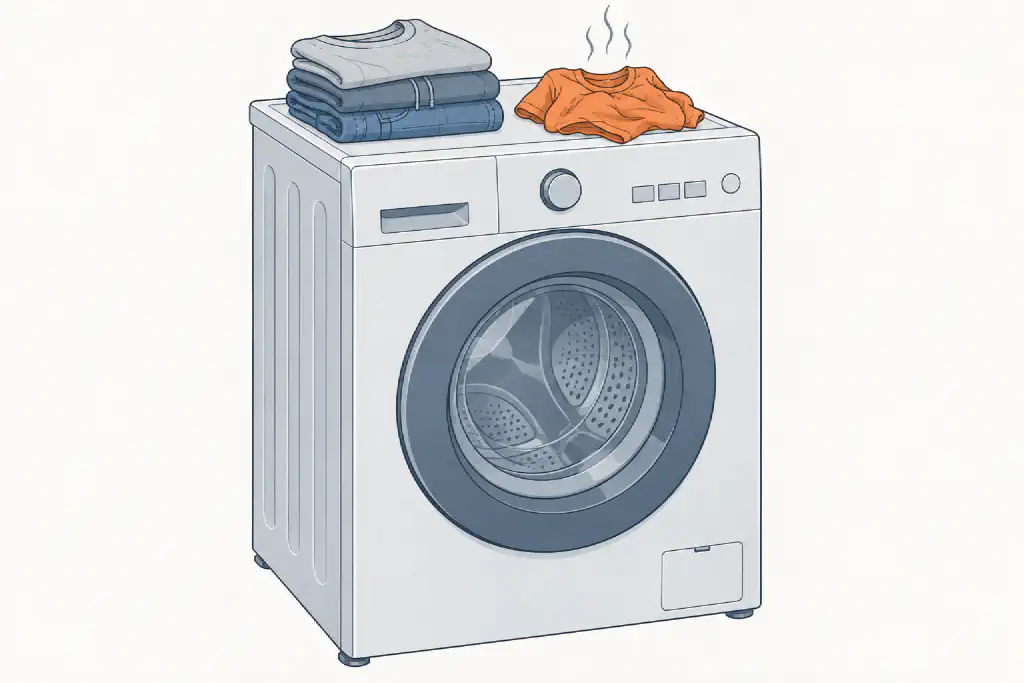
Say the load sat in the drum overnight, or came out of the dryer smelling like a damp basement. When clothes stay damp for long periods, Whirlpool explains, “mildew can form and cause unpleasant odors.” So wash it out, then dry fully.
Which musty load do you have?
- Every load smells, even ones unloaded right away. Whirlpool says the washer itself can sometimes be the source. Do the machine check first.
- Sour towels or sweaty workout clothes: see the towels or sweat guide.
- Anything else, blankets included: start at step 1, with these adjustments.
- Already dried and still musty: add oxygen bleach to your first rewash, if the label’s triangle allows. Whirlpool’s method for dried clothes starts with a vinegar soak; why this page skips it.
- Musty from storage: afterward, store it clean, dry and out of plastic bags, as Whirlpool advises.
- Gray or white powdery patches: Whirlpool describes mildew as “a powdery gray or white growth on fabric”. For any stain left once the smell is gone, follow the oxygen bleach package, if the label’s triangle allows.
Read the care label first
| On the label | What it means | For the rescue |
|---|---|---|
| Washtub with dots | More dots, hotter | Wash at the hottest it allows |
| Hand in a washtub | Hand wash | Same order by hand: warmest water allowed, sniff it wet, dry fully |
| Dry clean only | Not for home washing | Take it to a dry cleaner |
| Empty triangle | “any kind of bleach” (Clorox, a bleach maker) | Oxygen bleach OK (step 2 add-in and steps 4–5) |
| Triangle with diagonal stripes | “non-chlorine bleach or color-safe bleach when needed” (Clorox) | Oxygen bleach only, no chlorine |
| Crossed-out triangle | “should not use any bleach of any kind” (Clorox) | Skip the oxygen bleach (step 2 add-in and steps 4–5); repeat step 2 once |
| Wool, including merino | Woolmark advises avoiding “any detergents containing bleaches” | Our call: skip the oxygen bleach (step 2 add-in and steps 4–5); repeat step 2 once |
| Tumble-dry square, crossed out | “does not tolerate machine drying” (Wikipedia) | Line or flat dry |
One example of an oxygen bleach is OxiClean Versatile Stain Remover Powder ad . Whichever you use, check its package for fabrics to avoid. OxiClean’s product page also says to test on an inconspicuous area first.
The rescue wash, step by step
- Separate the musty items from the rest of the laundry to help keep the smell from spreading.
- Rewash as hot as the label allows, at the dose line (plus oxygen bleach if the load was already dried and the label allows). Measure detergent “according to the manufacturer’s package” (Speed Queen’s advice for towels); extra detergent and softener backfire. Leave out scent boosters (why boosters don’t work) and vinegar (why no vinegar).
- Sniff it wet, before it goes near the dryer. Whirlpool: “Once the mildew smell on your clothes is gone, it’s time to dry them.” Smell the thick parts: seams, waistbands, hoods. Clean? Go to step 6. Still musty? Step 4.
- Still musty: wash again with oxygen bleach, if the triangle allows. Whirlpool suggests this rewash and says to “Follow the instructions on the product label”; your washer manual says where additives go in a front- or top-loader. Never mix bleach with vinegar, ammonia or other cleaners, or run one straight after the other.
- Still musty: soak, then wash again. For towels, Whirlpool suggests a soak in an oxygen-based laundry additive before washing; this page applies the same soak to clothes. Follow the package for the amount and soak time, then wash again as in step 4 and sniff it wet. Still musty? See what to do next.
- Dry it completely, right away, in the dryer only if the label allows. Outdoors, Whirlpool says the sun’s UV rays “can help eliminate musty odors that may remain.” Feel the seams and waistbands before putting anything away: cool or damp means not dry.
Smells clean? To prevent a repeat, see why loads left wet or dried slowly go musty.
Why a scent booster won’t fix it
Our reasoning: a scent booster changes what you smell first, not the mildew in the fabric. If the mildew is still there, the musty smell is likely to come back once the clothes are worn or get damp. None of the sources we used recommends a scent booster for a mildew smell.
What about vinegar?
This rescue leaves vinegar out, because the rescue may end in a bleach wash. Whirlpool’s methods for clothes all use a vinegar pre-treat or soak, rinsed out before washing, and Whirlpool says it’s “not recommended to add vinegar to your washer”. Speed Queen’s towel refresh puts a cup in the wash instead. OxiClean says not to mix its product with chlorine bleach or other household chemicals, except in the wash with your detergent. Prefer Whirlpool’s pre-treat? Use it instead of every oxygen-bleach wash here (the step 2 add-in and steps 4–5), not before one.
Still musty, or every load smells?
Only this item is still musty, and fresh loads come out fine: the washer probably isn’t the source, so stop the rewash loop. If the label allows, try a line-dry in the sun (step 6).
The machine check
Sniff the empty washer with the door or lid open.
- It smells: work through the front-loader checklist or how to clean a smelly top-loader. Then rescue the load from step 1.
- Already cleaned it, and the smell came back within weeks? Read why the smell comes back.
- It doesn’t smell: see the habits that turn loads musty.